Does this question also cross your mind, how the softest and most premium bamboo socks are made? What magic happens to create such a masterpiece?
Bamboo socks have become the heart of the socks industry. They are the best option for everyday wear that comes with premium quality, without sacrificing fashion.
And the perfection of these socks makes people wonder how they are actually made. So here we are with the answer.
If you are a retailer, manufacturer, or consumer, this guide is for you.
Are bamboo socks made of bamboo?
Are bamboo socks made of bamboo?
Do you also think that bamboo socks are directly made from raw bamboo fibers? Well, you will be surprised after hearing this, but it’s not.
Bamboo socks are created from bamboo-derived cellulose, which is precessed into a textile fiber known as bamboo viscose or bamboo rayon.
We all know that bamboo is hard and rigid so to transform it into a soft wearable manufacturreres extract cellulose from bamboo pulp and then convert the cellulose into a fiber which is suitable for spinning into yarn.
That’s how hard bamboo turns into soft socks.
How bamboo socks are made
Harvesting the bamboo
The first step to create a good quality bamboo socks is harvesting a good bamboo.
The best thing about bamboo socks is that it grows rapidly, which means it is easily available, and some specific types of bamboo can also grow several feet in just a few days.
Apart from this, bamboo needs very less water. It can also grow with natural rainfall in many regions, which makes it even more efficient.
And the most amazing thing about bamboo farming is that it is low maintenance. It does not need pesticides and chemicals, which are harmful and expensive.
Its natural pest resistance property keeps it natural, and the cultivation process cleaner compared to other crops.
1. Bamboo turns into pulp
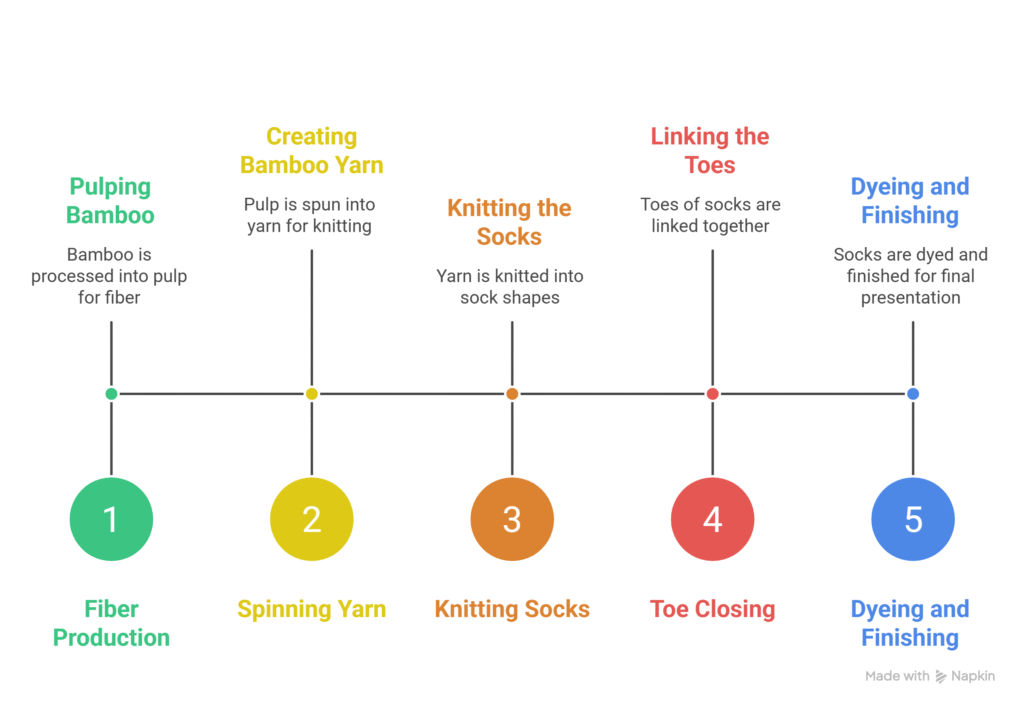
We all know that bamboo is hard and woody, so obviously, you can’t just create a pair of socks from it. It goes through some steps that convert the bamboo into pulp.
In the first step, the bamboo stalks are cut into small pieces or chips, which later go through a process where it extracts cellulose, which is a really important part that is needed to create textile fibers.
Now the question arises, what is cellulose? So it is a natural substance which is found inside plants that gives structure to plant cells.
So in the process of creating bamboo socks, this cellulose is separated from the rest of the plant material using various methods and ends up changing into a soft, thick paste which is called pulp.
2. Fiber production
- Chemical process-
After the bamboo chips convert into bamboo pulp, the bamboo pulp gets mixed with chemicals like sodium hydroxide, which prepares it for the next step and breaks it down.
After this, the bamboo pulp turns into a thick liquid, which is known as a viscous solution.
This viscous solution then gets pushed through very tiny holes in a machine called a spinneret, and then passes through another process where it becomes solid fibers.
Once the fibers are formed, they are spun into yarn, which can later be used to make fabric and socks. The main advantage of this method is that it produces very soft, smooth and comfortable fabric. That is why it is widely used for making bamboo socks and other clothing items.
- Mechanical process
The mechanical process is used very little compared to the chemical process as it’s expensive and takes more efforts and time. But it is a more natural way where bamboo is crushed with the help of a machine and not chemicals.
After that, some natural enzymes are added to it, which help in slowly breaking down the plant structure.
These enzymes separate the fibers from bamboo. When the fibers finally get separated, they are combed out carefully and then spun into yarn, which is later used to make fabric.
This method does sound good and safe and all natural, but the thing is, the socks that are made using this process are not as soft as the ones that are made using the chemical (viscose) method.
3. Spinning Bamboo Yarn
Once the bamboo fibers are ready, they are sent for the next step, which is turning the fiber into yarn, also known as spinning. In this process, the fiber are twisted together to create long, continuous threads that are later used to knit socks. During this process manufactures often mix bamboo fibers with other materials to improve the strength, comfort and overall performance of the socks.
For example, bamboo combined with cotton makes the socks more durable and long-lasting, whereas blending bamboo with polyester makes them cost-effective and stronger. So bamboo is blended with other fibers in this stage, and this process is very important because it directly affects how the socks will feel, how long they will last, and how well they perform in daily use.
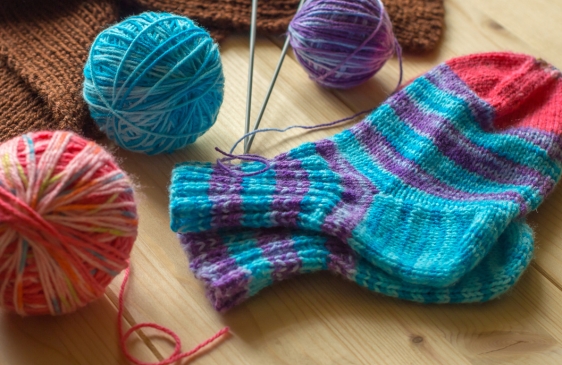
4. Knitting the Socks
When the yarn is ready, the next step is knitting the socks. In this stage, special machines called circular knitting machines are used.
These machines are specifically designed to automatically create the shape of a sock.
The yarn is fed into the machine, which knits in a continuous circular motion, forming a basic tube-like structure.
After this, the machine carefully shapes important parts of the socks, such as the heel, toe, and the ribbed cuff, which is the top portion.
The machines used for sock knitting are highly advanced and operate with great accuracy, ensuring consistency and quality in every pair.
5. Toe closing (Linking)
The next step is toe linking, where the toe area is stitched properly.
Here in this step, the toe area, which is also the end area of the socks, is stitched to give the socks a proper shape.
And this is step is also important because there are different ways to do it, and for a high quallity bamboo socks, the hand-inked or seamless toe closure step is followed.
This makes the inside of the sock smooth, with a rough or thick stitching that sometimes irritates the toe and fingers.
6. Dyeing and Finishing
Once the socks are fully made, the final step is to enhance their appearance, softness and overall finish. This stage is known as dyeing and finishing.
In this process, the socks are first dyed in different colours and designs based on product requirements. After dyeing, they are thoroughly washed to remove any excess chemicals or residues. The final stage focuses on improving the quality and feel of the socks. Softening treatments are applied to make them smoother and more comfortable.
In many cases, anit bacterial finishing is also added to help keep the socks fresh.
Additionally, a shape setting process ensures that the socks maintain their proper size and fit. All these steps together help create a high-quality and comfortable pair of socks.